

History
A History of the Banbury Run
The Greatest Cavalcade of Historic Motorcycles in the World by Annice Collett
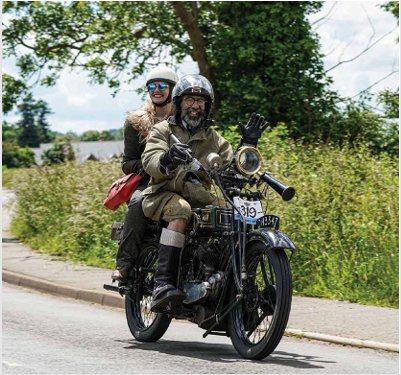
No event in the history of the club has had more far-reaching effects than the [Banbury Run]. A direct result has been an increase in membership but indirectly a tremendous impetus has been given to the vintage movement by this full-scale public demonstration. Titch Allen, Vintage Motor Cycle club (VMCC) Bulletin, July 1949 The Vintage Motor Cycle Club (VMCC) Banbury Run first took place in 1949, with 2025 seeing the running of the event for the 75th time - two years late because Covid-19 prevented it from taking place in 2020 and 2021. This Run is seen as a highlight of the year for riders, spectators, organisers, helpers and hosts. The Banbury Run is a timed competitive and social event run under the auspices of the Auto Cycle Union (ACU). It has been a restricted event since 1960 and a closed event since 1968. In 1996 only it was organised as a closed-to-club social run, but since 1997 it has been a closed-to-club event that the rider can choose to enter either as a time trial or a social run.
To be considered for the Concours D’ Elegance, machines must have started the Run with the intention of finishing but are not excluded if they fail to finish (criteria changed very recently – for much of the Run’s history only finishers qualified for the Concours) so this is not just a display of pristine unused and unrideable motorcycles. Since at least 1979 concern has been expressed that Concours machines are too good – better than they ever left the factory, but it is indisputable that to win here is testament to skill and often many hours of dedicated work. The Run has always been intended to be “intentionally tougher” than other runs, and this challenge proved popular with riders right from the beginning.
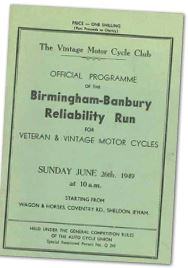
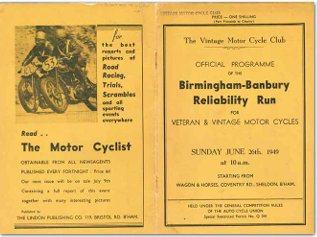
However, despite the doubts of the uninitiated, an entrant generally has a 95% chance of completion, even if sometimes it seems this is achieved by sheer will-power. The Run started back in 1949 after a discussion in the Dog and Duck in Shardlow, Derbyshire, between Ivor Mutton and other members of the VMCC’s nascent Midlands Section. Mutton proposed that “we should honour our forebears” with a run based around Banbury. His idea became the “Birmingham-Banbury Reliability Run for Veteran and Vintage Motorcycles” which took place on June 26th 1949. The April 1949 club bulletin described the Run as the “most ambitious event the VMCC has planned”. It was hoped that every member would compete or help. In 1950, this became The Banbury Run. In 1956, CE “Titch” Allen, the VMCC’s founder, wrote that to educate the new generation and honour an older one was “no less than the club’s duty”. Given its proximity to the manufacturing centres of Birmingham and Coventry, in the early years of motoring the Banbury area had seen many works test riders experimenting with how well the latest model could cope with actual road conditions such as Sun Rising Hill. The demanding length and incline of this hill would have seen the death of a few designers’ dreams but the vindication of many others’ innovative plans. The area was the “principal proving ground for the Industry”. Banbury was also the focus of many of the early ACU Quarterly Trials and other similar events. Banbury Cross was often used as a turning point or a central starting point and huge crowds were attracted to the town to watch these brave pioneers as they battled with rough, rutted, dusty or muddy roads, easily punctured tyres, unreliable spark plugs, slipping drive belts, rudimentary brakes and virtually no suspension. The programmes for the early years of the Run frequently allude to the greatness of the British Motorcycle industry and the part the early machines played in this. In return, the industry’s support of the Run is reflected in advertisements by manufacturers including BSA and Velocette, dealers such as Conways and Slocombes, and suppliers including Shell and Smiths. There were also “works entries” from Ariel and James - 1981 saw a “works entry” from Bulmer’s cider. “Carbon” of Motorcycling magazine (Capt. Francis Jones) wrote of the 75,000 British bikes exported annually, there was a general understanding that the success of the British bike Industry had been “made possible by the efforts of the pioneers” as seen on the Run.
The Classes
Manufacturers tend to adopt new trends at similar periods for fear of looking old-fashioned and of their products becoming technically outdated. We can see distinct differences between Veteran (up to 31st December 1914) and Vintage (1st January 1915 to 31st December 1930) machines, but these two divisions have never been sufficient for this Run.
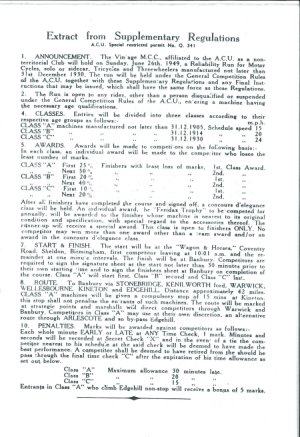
The entries are principally divided into classes by year of manufacture, although a smaller engine size, the presence of a sidecar, or to a degree the rider’s age or preference can put them into a different class. The number and definition of the classes has changed over the years, but the usual division now is that Veteran machines are in class A. Class B covers the Early Vintage machines built up to 31st December 1924, and class C Late Vintage machines from 1st January 1925 to the end of 1930. However, in 1949 class A was up to 31st December 1905 and in other years 1907, 1908 and 1909 were used as the cut-off point for this class.
In past years the classes were A B, C or A, B, C, D, although in 1957 the classes - inexplicably – were A, B, C, E albeit using similar age-bands to other years. In 1952 and 1953 there was a separate “Selling” class for machines available for purchase - what better road test could a potential purchaser expect to see?
An average speed is specified for each class, and the rider’s objective is to complete the course without navigational errors in a time that is as close as possible to the theoretical time for the distance. As of 2025 we have A, A1, B and C with average speeds of 15, 18, 20 and 24 mph respectively. At first glance these speeds seem very low but if you are nursing a recalcitrant 125-year-old through modern traffic they can seem very demanding, particularly since riders do not know the exact length of the course, and for the minority of machines with speedometers (which were not required by law until 1936) the mileometer must be covered up. Nevertheless. a few entrants fail to achieve a first class award each year by being too quick.
The date of the Run has varied. In 1949 the plan was for the fourth Sunday in June, but this has only happened in 15 of the 75 years. In 1951 it was the fourth Sunday in July. In recent years it has mostly been on the third Sunday of June – Fathers’ Day.
The Motorcycles
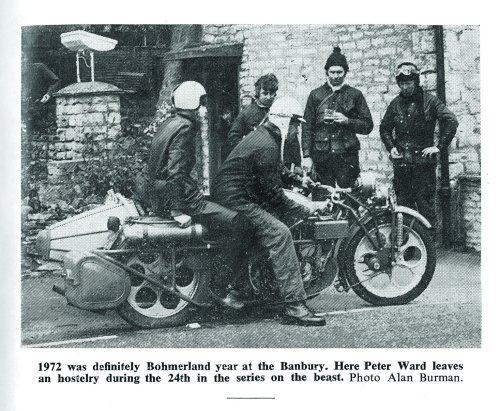
Each year the machines get a little more ancient and more precious to us. When the Run started the oldest machine (a 1902 Clement Victoria) was 47 years old and the youngest (a number made in 1930) were 19 years old. At the time any machine made before 1931was eligible to be used in VMCC events – the current eligibility rule of 25 years or older did not come in until the 1960s. Now the newest machine in the event will be nearly 95 years old. The oldest machine on the run for many years was an 1897 Beeston-Humber tricycle first entered in 1952, although this is matched for the 2025 Run by an equally-venerable 1897 Léon Bollée.The motorcycles cover almost every type and size you could imagine. At one extreme are the Wall Autowheel or the JES, essentially just heavyweight bicycles with small 1hp engines attached in a variety of ways. At the other extreme the event has seen an American-built,1300cc, four-cylinder Henderson, and a Czech-built Böhmerland Langtouren, with seating for three and the longest production motorcycle ever made. They include ones that gained kudos in all forms of competition as well as everyday commuters. In 1951 Joe Tite was on the actual 499cc Rudge that Wal Handley had ridden to victory in the 1930 Isle of Man TT. Eric Langton’s 1902 Zedel, on the other hand, had been rescued from a scrapyard in 1937.Motor vehicles over 40 years old no longer have to pass an MoT test every year, but since the Run takes places on public roads all must be fully roadworthy. In the event’s early years it was not uncommon for machines to be ridden to the start and, assuming no catastrophe had occurred, ridden home again afterwards, but given today’s traffic and the long distances travelled by many entrants most now arrive in a van or on a trailer. Writing in 1953, the former champion race rider Geoff Duke thought that by 1973 we would be riding super-sonic radar navigated jet cycles and whilst this is not yet quite the case, his point was that there was, and still is, a lack of comprehension about how in the Veteran and Vintage years people could possibly achieve the distances and speeds that they did on primitive machines full of idiosyncrasies. Some machines, such as The Dreadnought from 1902 – the world’s oldest surviving trials motorcycle - do demand a huge level of skill and experience, whilst most of the Late Vintage machines are very ridable and amenable should a newcomer fancy a go.The Programme entries were at one stage drafted by one of the Club’s wordsmiths, but are now written by the entrant and often contain humorous insights into the tribulations of ownership such as “suspended in a northern pub for many years [hence] the wobbles” or “caught fire last year”.
Entrants and Organisers
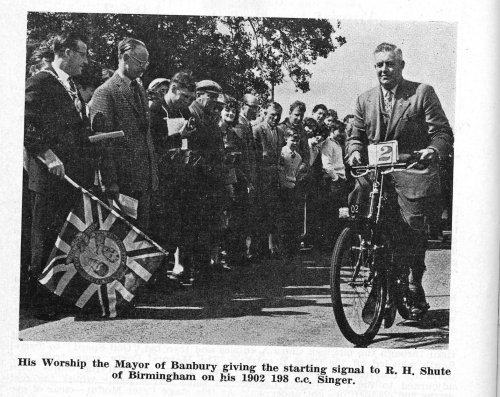
The first Run saw 81 intrepid riders set out, watched by over 2000 spectators at the start in Birmingham, and more at Banbury. Some of these riders had first met their machines when they were new. By 1953 241 optimists saw the event’s attraction and by 1957 numbers had grown to 349. Figures stayed fairly consistent up to 1987 when 430 entries were accepted. In 2001 500 riders took part whilst 2008 saw the limit raised to 600. In most years the Run was oversubscribed. Numbers dropped back to a more manageable 500 in 2015 and, along with every other event, after the Covid pandemic numbers dropped further. In 2024 there were 291 riders, and for 2025 around 300 now seems to be the new norm.Some riders are nearer retirement than birth. Having said that we are gratified that many younger people take part each year. Some have entered at 16 or 17 as soon as they were legally able to ride. The run is often a family affair – both the one you are born to and the one you choose – grandparents, mothers, fathers, sons, daughters, siblings and cousins have all entered as teams or individuals. Many riders comment on the camaraderie. The Run is a serious motorcycling event not a fancy-dress show, but entrants have included a chimney sweep complete with brushes, nurses, First World War Despatch Riders, and many other nattily attired men and women as recognised by the Banbury Town Mayor Trophy.Of the brave souls that choose to pit themselves and their machines against the local roads and the British weather, there have been a good number of famous faces. From the world of competition motorcycling – trials, road racing and speedway, these include: H.R Davies and G.S. Davison (TT) Oliver and Eric Langton (speedway), and Sammy Miller MBE, Don French, Bill Fruin, Rex Judd, Edith Spokes and Jill Savage (trials). Notable motoring journalists and writers include Bob Currie, Norman Vanhouse, and Jeff Clew, whilst the event has attracted the attention of many media personalities including Alan Cathcart, Henry Cole and Sam Lovegrove. John Masterman’s entry in 1949 noted he had ridden to 19 countries in Europe, Asia and Africa including a three-week trip to Istanbul and back in 1939. By 1967 his tally was 21 countries, averaging 20,000 miles a year. He also rode in at least three Lands’ End Trials on his 1928 Norton. Titch described this bike in the July 1949 VMCC Bulletin as “bearing the filth of 9 countries and the rust of 20 years”, whilst the 1956 programme mentions that Masterman explicitly did not want to enter the Concours as the machine still bore most of the mud and dust of its travels: one perhaps hopes it still does. 1957 saw the first overseas entrant when Henry Wing Snr of Massachusetts rode a 1905 Indian 187cc single. Since then, there have been riders from all points of the globe.The organisation of an event this large and complex requires the help of many volunteers. To give some idea of the scale, in 1952 the club had 400 members and there were 189 entrants in the run, albeit entries were not closed-to-club. For many years most of the work was done by the VMCC’s Sections in the Midlands group. For a while much of the organisational and administrative work was handle by the Club’s paid staff, but since 2022 the focus has moved back to volunteers who in the internet age can now be geographically very spread out.Many of the great and the good have honoured the VMCC by participating in the event’s organisation. A few of those famous outside the Club can be noted. From 1949 to 1962 H. Rem Fowler (winner of the first TT in 1907) was involved as a scrutineer, steward or judge. In 1949 his fellow scrutineer was H.R Davies (HRD of Vincent-HRD), whilst the Introduction to the Programme was written by “Ixion” (Rev. Basil H. Davies) and “Carbon” was a judge. 1950 featured Bert Perrigo (trials rider) as a judge and Mrs Doris Taylor (a renowned event official) as a timekeeper with the programme introduction being by Carbon. In 1951 Jim Ferriday of Feridax took part as a judge along with E.C.G. Baragwanath (racer): Major H.R. Watling (Director of the British Cycle and Motor Cycle Manufacturers and Traders Union) wrote the Introduction, and the Mayor of Banbury served as the starter.
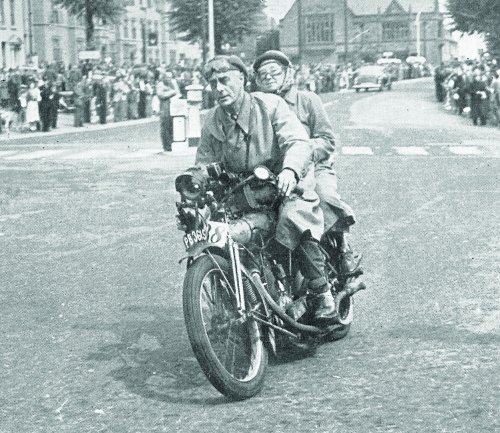
Two up on the 1953 event - we haven't identified the riders, but crowds were lining the streets
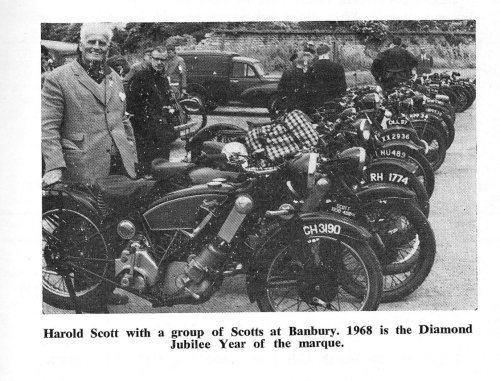
Mrs Watson Bourne, better known as Marjorie Cottle in her day the “world’s most famous trials rider” took duty as a steward or judge from 1954 to 1957. Hugh Palin MBE (a director of the Cycle and Motorcycle Association, Managing Director of Norton Villiers and President of the MCIA.) stewarded for 21 years from 1954. Other luminaries including Erwin Tragatsch, Harold Scott (nephew of motorcycle manufacturer AA Scott), Bob Currie, Harold Karslake, Jim Sheldon, race riders H.G. Tyrell Smith, F.P. Heath and Charles Mortimer have all been either judges or stewards. In 1979 notable trials and race rider Olga Kevelos presented the prizes. Ian Young’s commentary was always pertinent. In 1967 Charles Mortimer’s Racing School provided the breakdown/recovery service, which may have added an exciting element to counter the misery of machine failure!
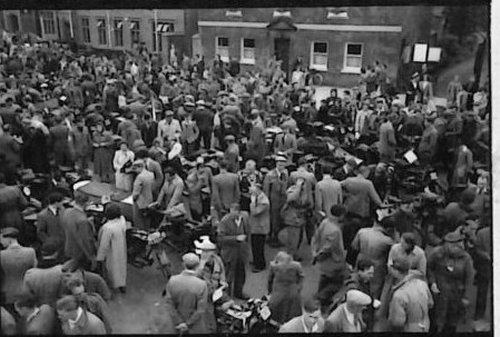
Many other clubs have taken part over the years. The Vintage Sports Car Club Light Car Section helped with marshalling in 1953 as did the Leamington Victory and other local motorcycle clubs. One-make clubs such as the London Douglas Motor Cycle Club and the AJS and Matchless Owners Club have joined us to celebrate their anniversaries. The tradition continues in 2025, with the Triumph Owners Motor Cycle Club (Meriden Branch) running checkpoints, and riders from the Royal British Legion working as Travelling Marshals on the course. ore crowds at the start of the 1953 RunMany other clubs have taken part over the years. The Vintage Sports Car Club Light Car Section helped with marshalling in 1953 as did the Leamington Victory and other local motorcycle clubs. One-make clubs such as the London Douglas Motor Cycle Club and the AJS and Matchless Owners Club have joined us to celebrate their anniversaries. The tradition continues in 2025, with the Triumph Owners Motor Cycle Club (Meriden Branch) running checkpoints, and riders from the Royal British Legion working as Travelling Marshals on the course.
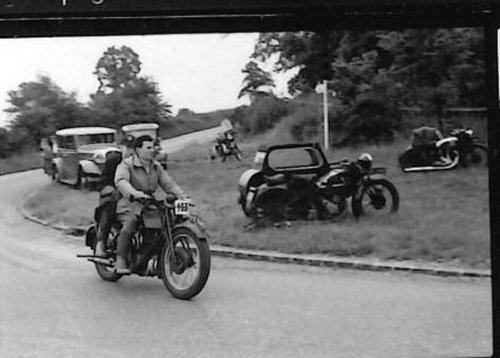
The 1977 programme cover featured “warm good wishes for a successful day” from Her Majesty Queen Elizabeth II. . Jenkins rounds a corner - note the historic spectator transport!The 1977 programme cover featured “warm good wishes for a successful day” from Her Majesty Queen Elizabeth II.
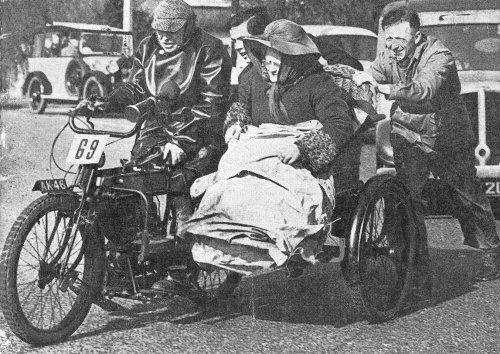
The Start
In 1949 the Run went from Wagon & Horses, Coventry Road, Sheldon to the Market Place in Banbury. The landlord of the Wagon & Horses, Doug Copley, rode his own Baby Triumph. The next year the event started at the Crown Hotel, Banbury and ran to the BSA Sports Ground in Small Heath, Birmingham. After that the event settled down to the start and finish in the same place. Start points in Banbury have included the Horsefair, the Midland Mart car park, Castle Gardens car park, Grimsbury car park and, from 1980 to 1986, Automotive Products.
From 1958 to 1960 the Run was based at Honeybourne Aerodrome near Evesham. Shenington Airfield hosted it in 1961, and in 1962 and 1963 the event ran from the Royal Engineers Supply Depot at Long Marston. 1987 saw the Run in the impressive surroundings of Blenheim Palace at Woodstock. The venue was Drayton School from 1988 to 1995, followed by Towcester Racecourse from 1996 to 1999. In 2000 we returned to the school until 2007. After many years happy association with the school, who saw it as a highlight of their year and a vital fundraising opportunity the event finally outgrew them. In 2008 the Run moved to the British Motor Heritage Museum at Gaydon, where it has remained.
The Route
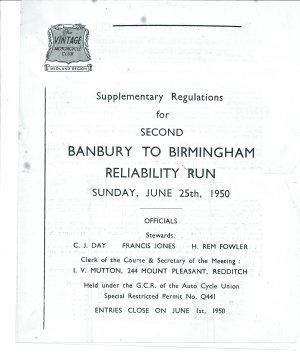
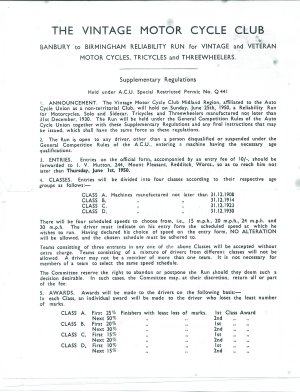
The route of the Banbury Run has varied over time depending on the start/finish location. Ivor Mutton assured members that the 1949 route was “fairly easy as Kenilworth Ford has a concrete bed and only three hills that might require LPA” (Light Pedal Assistance). He noted that Edgehill is “not so outstandingly severe but is rather lengthy” (a 300 ft rise in 1000 yds). The route usually passes Banbury Cross and, apart from in 1987, Sun Rising Hill has featured every year since 1954.It has included many well-known towns and villages in the area including Broadway, Chipping Norton, Cropredy, Gaydon, Halford, Kenilworth, Kineton, Leamington, Moreton-in Marsh, Stow-on-the-Wold, Towcester, Winchcombe, Woodstock, Wroxton and many others. The first year included Warwick and the second year saw riders pass through Solihull.Sun Rising is not the only hill embodying the potential for despair or exaltation. Aston Hill, Bakers Hill, Dover’s Hill, Edgehill, Saintbury Hill, Saltbury Hill, Steepness Hill and Stoneleigh Hill have all been used in the past. Sometimes these hills were observed so extra points could be gained.The length of the run also varies. For many years the pattern has been two routes, short and long, which partially overlap. Current practice (2025) involves a short route, from 20 to 50 miles and avoiding any really steep gradients, intended for the oldest and least powerful machines in classes A and A1. It also involves a long route, from 40 to 75 miles and now always including the ascent of Sun Rising Hill, for the newer and more powerful machines.The early years featured an organised lunch stop and a special engine restarting test and there were observed non-stop sections. The restarting test might have caused more trepidation for some riders then the dreaded hills - everyone knows that older motorcycles can sometimes refuse to start when they have an audience.The Trophies and AwardsA considerable number of trophies are awarded to participants in the Run, whilst those riding competitively rather than socially and who complete the run are eligible for a Gold or Silver Award depending on their score. The eligibility and criteria for each trophy is listed in each year’s Regulations. Appendix One sets out the most recent Regulations (2025), whilst for historical interest Appendix Two reproduces the oldest-known surviving Regulations, for 1950. The origin of some of the Trophies has been lost over time, and the author would welcome any additional information.
The Trophies and Awards
A considerable number of trophies are awarded to participants in the Run, whilst those riding competitively rather than socially and who complete the run are eligible for a Gold or Silver Award depending on their score. The eligibility and criteria for each trophy is listed in each year’s Regulations. Appendix One sets out the most recent Regulations (2025), whilst for historical interest Appendix Two reproduces the oldest-known surviving Regulations, for 1950. The origin of some of the Trophies has been lost over time, and the author would welcome any additional information.
Feridax Trophy first awarded 1949
JR Ferriday, the founder of Feridax, was a judge from 1951. VMCC Founder Titch Allen was a sales representative for Feridax, and encouraged the company’s association with the club. Feridax have always supplied motorcycling accessories, hence the emphasis on this in the selection criteria.
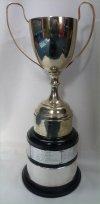
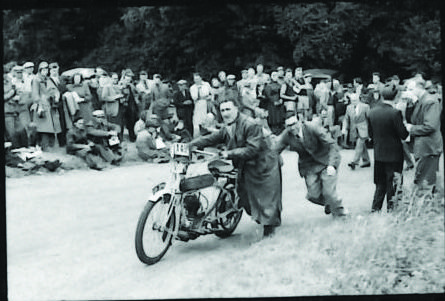
Opposite Class Trophy first awarded 1953
In practice, second prize to the Feridax Trophy. If the winner of that is a Veteran machine this trophy will go to a Vintage machine and vice-versa: hence “best opposite class”.
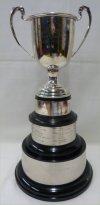
Premier Trophy first awarded 1953, last awarded 1958
For the rider who completes the course in accordance with the Regulations, with the greatest number of marks to their credit
Best Opposite Class (to Premier Trophy) first awarded 1953, last awarded 1958
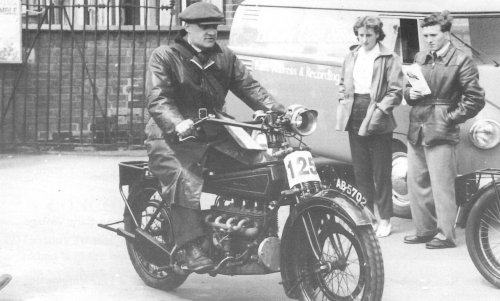
Founders Trophy first awarded 1953, last awarded 1962
For the best performance on a Veteran machine.
Selling Class Trophy only awarded in 1953 and 1954
The first winner J.J. Allen correctly entered the class, but the compiler of the programme missed him from the class list!
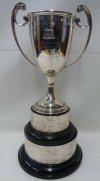
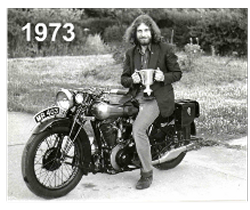
Sheldon Trophy first awarded 1955
The August 1955 VMCC Bulletin subtitled this award “Find of the Year”. James (Jim) Sheldon, a “well-known contributor to the motor cycling press and a leading member of the VMCC” wrote the best book on early motorcycles - Veteran and Vintage Motor Cycles, published by Batsford 1961. He trained as an accountant and an engineer and to paraphrase his words rode “a lot of motorcycles a long way over a long time in a lot of countries.
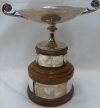
Joe Tite Memorial Trophy first awarded 1959
Originally Awarded to the youngest VMCC member gaining a first-class Award. Joe was “a great friend” to the Club and “one of our most popular members” who died in a road accident in 1958.
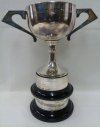
Rotherham Challenge Cup first awarded 1959
Originally awarded to the youngest female VMCC member gaining a first-class Award. The Rotherhams were stalwart members over the years and served at the highest levels. W.J. Rotherham was club President from 1975 to 1977.
Percy Wheeler Memorial Trophy first awarded 1960
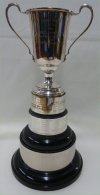
Scott Shield first awarded 1969
Awarded by HH Scott.
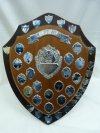
Twycross Trophy first awarded 1969
Tony Twycross was a feature of the Banbury run and the club in general. A leading restorer, he often rode very interesting and rare machines. In 1971 he rode a 1901 Orient reputed to be the oldest American machine still running. Assuming this is the same Twycross, he won his own award in 1972.
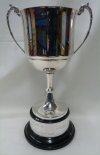
AMCA tankard only awarded 1971
Presented by American entrant, Art Sigal, for furtherance of international friendship to the best machine of other than UK manufacture
Brough Superior Trophy first awarded 1972
Presented by Albert LG Wallis, 1910 to 1999, Albert’s first contact with Broughs was cleaning the one belonging to the son of the big house where Albert’s father was employed. He was a railwayman until, in 1966, he started a motorcycle business near Bedford, continuing until 1975. He got his first Brough, an 11-50, around 1956/7. He was instrumental in forming the Brough Superior Club and made spares for Brough Superiors for many years. Albert was very focussed and multi-skilled. He owned a number of rare Broughs including the one with an Austin 4 cyl engine, the transverse twin and the Dream. His son continues Albert’s passion for these machines.
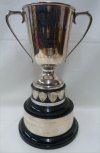
Susan Moore Memorial Trophy first awarded 1976
Origins unknown.
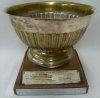
Bill Moore Trophy first awarded 1978
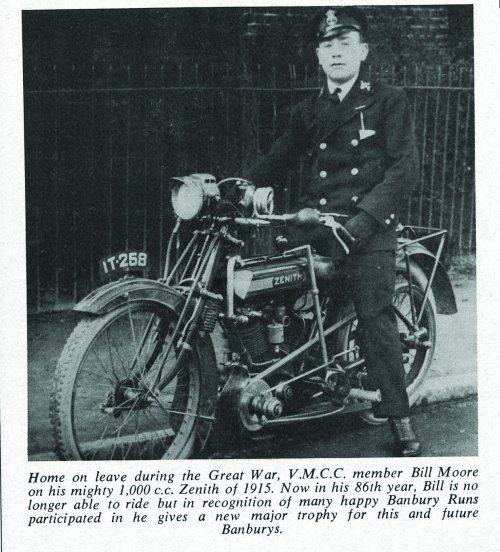
Bill Moore started riding in 1908 and rode at Brooklands. He appears on the cover of the 1978 programme. The Trophy was given in recognition of many happy Banbury Runs. He was 86 in 1978 and no longer able to ride.
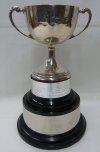
Jack Groves Memorial Trophy first awarded 1979
Jack Groves’ obituary appeared in the VMCC Journal for March 1979. He was a First World War despatch rider who became one of the first to drive a tank. After the war he used a BSA outfit to deliver the post from Woodstock to Shotover. He became one of the oldest and most respected members of the Oxford section and entered as many events as possible, often winning Concours awards.
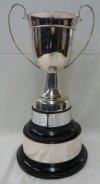
Wootton Trophy first awarded 1980
Presented by TF Wootton, club President from 1977 to 1979, and Mrs B Wootton
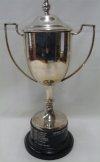
Harold Scott Shield first awarded 1980
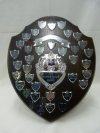
Arthur Mortimer Trophy first awarded 1980
Arthur Mortimer was club President from 1969 to 1971, editor of the Journal 1965-76, and a staunch member of the Cotswold section from the early 1960s. He was very involved in the Western Region Championship and the Cheltenham International. Arthur instigated the KOBI Brotherhood in 1967 (ask a local member!). Many were saddened by his death in early 2014.
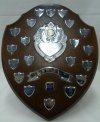
Past Masters Class first defined for 1980
This comprises The Harold Scott & Arthur Mortimer Trophies which are awarded for machines that have previously won a Concours or class award at Banbury.
Timothy Smith Memorial Trophy first awarded 1981
Origins unknown.
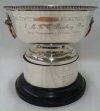
Len Wills Memorial Scroll first awarded 1981
Len Wills, a pharmacist in Coventry, joined the club in 1949. One of “nature’s gentlemen”, he was an “indefatigable worker on behalf of the club” who served for many years on the Management Committee and became a Vice President in 1978.Len died on March 23rd 1980. His son Mike is was VMCC President in 2019-21, and continued his father’s love of Bradbury machines.
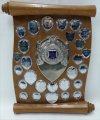
Automotive Products Trophy first awarded 1980 until 1991
Awarded for the oldest machine to finish the run.
British Bike Award only awarded in 1991
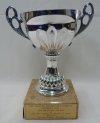
Drayton School Trophy first awarded 1993
Originally awarded to the oldest machine
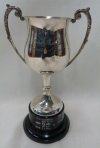
Ivor Mutton Founder's Award first awarded 1995
Having originated the Run and working very hard to ensure it happened each year, Ivor Mutton was not himself able to ride in it until 1955. In July 1949 Titch wrote that the “run was only made possible by the vision, hard work and sheer determination of Ivor Mutton”. His daughter, Pat Warren, remembers their house being full of boxes of paperwork and trophies for many months each year. He and his four-cylinder prototype RE featured on the cover of the 2008 program. Ivor was made a club Vice-President in 1952
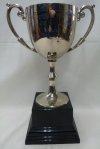
Banbury Town Mayor Trophy first awarded 1995
Miniature Cup first awarded 1997
Awarded by Stan Greenway, who founded the VMCC Cyclemotor Section in 1981. His passing was remarked upon with sadness in October 2000.
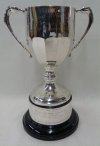
Vintage Tyre Scheme Trophy first awarded 2001
Presented by Joyce Cobbing
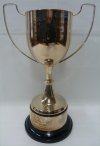
Ken Cobbing Trophy first awarded 2001
Presented by Joyce Cobbing
Ken rode a 1925 Ner-A-Car in the 1949 run. Joyce first rode the event in 1955 on a 1927 Royal Enfield. They met through riding and both rode a variety of interesting machines. Ken and Joyce worked very hard in their business supplying after-market accessories and ran the Vintage Tyre Scheme. This innovation ensured that riders were able to source suitable tyres that were unavailable anywhere else. After Ken’s death in 1988, Joyce looked after considerable collection of machines along with her donkeys, sheep and fowl until her death in January 2015.
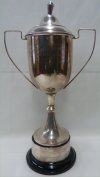
Kevin Thomas Trophy first awarded 2002 (origin unknown)
Origin unknown
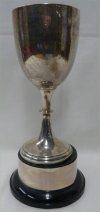
Newcomer's Trophy first awarded 2008
Presented by the German equivalent of the VMCC, the Veteranen-Fahrzeug Verband eV.
To Conclude
“Old Motorcycles do not die neither do they rust away”, so long as a VMCC member discovers them in time, was the view of VMCC Founder Titch expressed in 1957. Geoff Duke wrote in the 1953 introduction that to “appreciate (fully) the stepping stones of progress … you must see them in action, listen to their struggling beat, savour the smell of hot oil and uncertain mixture”. He could have added that one should feel the vibration and even taste the smoke to thoroughly enjoy the complete sensory experience available.
Titch presciently worried in1960 that the type who likes to experience thrills first hand rather than reading of others derring-do was rapidly disappearing. However, the reality that hundreds of riders and thousands of spectators still turn out for this event every year argues that the type is, thankfully still with us.
Annice Collett
VMCC Library
April 2025
Sources
- Allen, Titch, Untitled, Vintage Motor Cycle Club Bulletin, Apr 1949 p2, p8; July 1949 p1
- Anonymous, B & B Recollections, Vintage Motor Cycle Club Bulletin, July 1949 p6
- Anonymous, The First Birmingham to Banbury Reliability Run for Vintage and Veteran Motorcycles, June 26th, Vintage Motor Cycle Club Bulletin July 1949 p8
- Anonymous, The Banbury Run, Vintage Motor Cycle Club Bulletin, Aug 1955 p4-6
- Anonymous, The Late Mr. J. R. Tite, Vintage Motor Cycle Club Journal, Feb 1958 p32
- Beale, Dennis, Mrs Joyce Cobbing, Vintage Motor Cycle Club Journal, July 2015 p 97-98
- Boulton, Jim, The Banbury Run, Vintage Motor Cycle Club Journal, June 1971 p 4
- Boulton, Jim, The Banbury Run, Vintage Motor Cycle Club Journal, Aug 1972 p 252
- Boulton, Jim, Obituary – Len Wills, Vintage Motor Cycle Club Journal, May 1980 p 236
- Button, Paul, Arthur Mortimer 1930-2014, Vintage Motor Cycle Club Journal, Mar 2014 p 77
- Davison, G.S. ed, The Banbury Run, Vintage Motor Cycle Club Journal, Aug 1960 p157-9
- Hodgins, Chas. obituary - Jack Groves, Vintage Motor Cycle Club Journal, Mar 1979 p 110
- Hummerstone, Alan, Cyclemotor, Vintage Motor Cycle Club Journal, October 2000 p 705
- Mutton, Ivor Midland notes, Vintage Motor Cycle Club Bulletin, July 1949 p6-7
- Mutton, Ivor, Midland Group, Vintage Motor Cycle Club Bulletin, May 1949 p2; June 1949 p6
- Mutton, Ivor, The Fifth Annual Banbury Run 1953, Vintage Motor Cycle Club Bulletin, May 1953 p2
- Platt, R. H., Another Beautiful Banbury Run – The Greatest Free Show on Earth, Vintage Motor Cycle Club Journal, Aug 1979 p 308-9
- Underhill, John, Obituary – L. H. Wills, Vintage Motor Cycle Club Journal, May 1980 p 236
- Various, Banbury Run programmes, 1949 to 2024
- Young, Ian, Arthur Mortimer 1930-2014, Vintage Motor Cycle Club Journal, Mar 2014 p 77-78
- All of the source material is held in the VMCC’s Library and Archives collection.